Showing posts with label Biodiversity. Show all posts

Saturday, December 05, 2009

International Polar Year - Oslo Science Conference


The International Polar Year - Oslo Science Conference will happen in 8-12 June 2010.

The IPY Oslo Science Conference will demonstrate, strengthen, and extend the International Polar Year's accomplishments in science and outreach. The conference is an essential opportunity to display and explore the full breadth and implications of IPY activities. The international and interdisciplinary science conference will in particular highlight the global impact of the changes that have been observed in the Polar Regions.

The conference venue will be in Lillestrøm - just outside Oslo. Most participants will be acommodated in the city centre, where we also will gather for social events.

The deadline for abstract submission is 20th of January 2010.

More information here.

Friday, November 13, 2009

Third Darwin Scholarship Programme: Monitoring and Communicating Biodiversity

Third Darwin Scholarship Programme: Monitoring and Communicating Biodiversity (13-23 August, 2010)

The Darwin Scholarship Programme has been running since 2008. Over 40 people from 25 countries have attended. Feedback from the programmes have been tremendously positive
In 2010 we will be running the third Darwin Scholarship Programme. We are now inviting applications for the 25 places that are available.

The scholarship programme is aimed at…
Young Scientists from around the world, probably working for an non-governmental organisation, government department or in a Biology or Ecology faculty at University. You should be under the age of 35 and studying at graduate or post graduate level or be a young lecturer or work for an environmental organisation.
The aim of the Darwin Scholar Programme is to develop “better naturalists” in the spirit of Darwin’s love of nature and observing the natural world. The Scholarship will focus on three areas - skills of observation and identification - skills of recording biodiversity and skills of communicating biodiversity to different target groups
This is a unique opportunity to work with leading scientists and educators in the UK and will be based in Shrewsbury - a beautiful historic English market town and the birthplace of Charles Darwin.

More information here.

A special thanks to Tatiana Maria for informing me about the Programme!

Friday, July 25, 2008

News from World Conference on Marine Biodiversity


The page of the World Conference on Marine Biodiversity was finally updated with information concerning the Programme, stands and also a message from the Co-Chairs about the attendance list (the problem of the waiting list).

The Conference will be in Valencia, Spain, from 11 to 15th of November. Check out the new information here.

Tuesday, March 18, 2008

World Conference on Marine Biodiversity


The World Conference on Marine Biodiversity will be in Valencia from 11 to 15th of November 2008.

The Aims of the conference are:

- To review the current understanding of marine biodiversity, its role in marine ecosystem functioning and its socio-economic context
- To assess current and future threats and potential mitigation strategies for conservation and regulation of marine resources
- To identify future research priorities

The deadline to submit abstract(s) is 1st of April! More information here.

Wednesday, December 27, 2006

Manuela Project


Considerable scientific progress has been made in describing structural aspects of marine ecosystems and in particular the determinants of the distribution and abundance of larger-sized species and their assemblages whereas the smaller-sized fauna has been largely neglected.

The objective of Manuela is three-fold:
  1. To integrate the currently fragmented information on the dynamics and functional role of meiofaunal
  2. To improve understanding of how the activities of meiobenthic organisms, population dynamics and community assemblages are linked to ecosystem processes
  3. To facilitate meiobenthic research within the MarBEF community and stimulate the interest in meiobenthology.
Further infomation on MANUELA PROJECT

Sunday, November 19, 2006

About Nematoda (Part 1)

Nematoda is usually the most abundant group within the meiobenthos, frequently with densities up to 10 million for 1 square meter.

I will use a series of posts to talk about this group. So, let me begin with a general overview...

Part 1: Who are the Nematoda?

From the greek nema = thread or line, also known as round worms. This name was used for the first time by the researcher Pott in 1932.

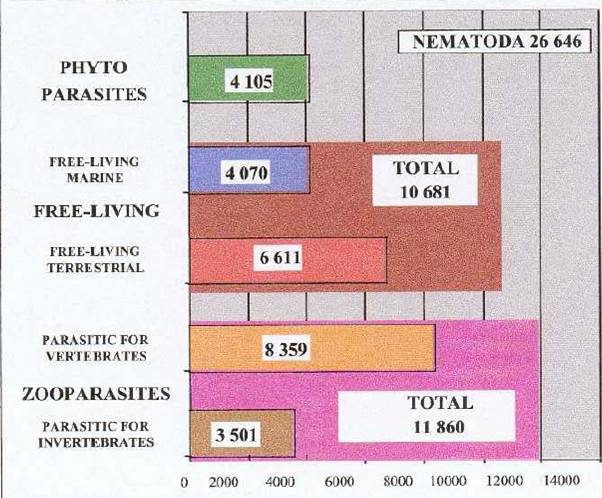
Nowadays exist more than 26 thousand species but this number has been increasing every year. Some number speculations varies from 1 to 100 millions.


The nematodes habit all kind of environments: marine, terrestrial and freshwater; and parasite all levels (plants, invertebrates and vertebrates). Most of the species described are parasites but estimatives show that free-living species are much more numerous than the almost 11 thousand species known until now. One of the many justificatives for this fact is the higher number of nematologists studying parasites when compared with those dedicated to the free-living ones.

The evolutive characteristics which separate Nematoda as a phylum are:
- presence of sensitive structures anteriorly,
- presence of vulva,
- spicule aparatus,
- post embryo development in 4 or more stages.

The closest phylum is Gastrotricha which is also part of meiofauna but is found in lower densities than Nematoda.
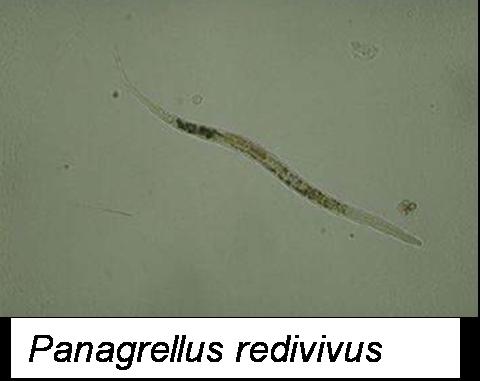
The first nematode was discovered in 2500 B.C., the human parasite Ascaris lumbricoides. The free-living ones were discovered in 1656 into the vinegar, more specifically the genus Panagrellus.


High densities of Nematoda make this group the most abundant phylum of metazoarians of our planet... About this the nematologist Cobb made this declaration:

“Iff all matter in the universe except the nematodes were swept away, our world would still be dimly recognizable.
We would find mountains, rivers, lakes and oceans represented by a film of nematodes as well as the location of towns and various plants and animals since there would be a corresponding massing of certain nematodes.” (Cobb in 1914)